
Meta Description: Explore how geopolitical tensions, gold prices, oil markets, and currency movements are shaping global financial markets in 2026. Learn what traders and investors should watch next.
Introduction
Global financial markets in 2026 continue to be heavily influenced by geopolitical developments, central bank policies, and commodity price movements. From the ongoing tensions in the Middle East to the evolving Russia-Ukraine conflict, investors worldwide are closely monitoring events that could impact currencies, gold prices, and energy markets.
For traders, understanding the relationship between geopolitics, gold, and currencies is no longer optional—it is essential. Safe-haven assets such as gold often react sharply to uncertainty, while currencies fluctuate based on economic expectations, interest rates, and global risk sentiment.
In this article, we examine the latest geopolitical developments, their impact on gold trading, and what currency traders should expect in the coming months.
Middle East Developments Continue to Influence Global Markets
The Middle East remains one of the most important regions affecting global energy prices and investor sentiment.
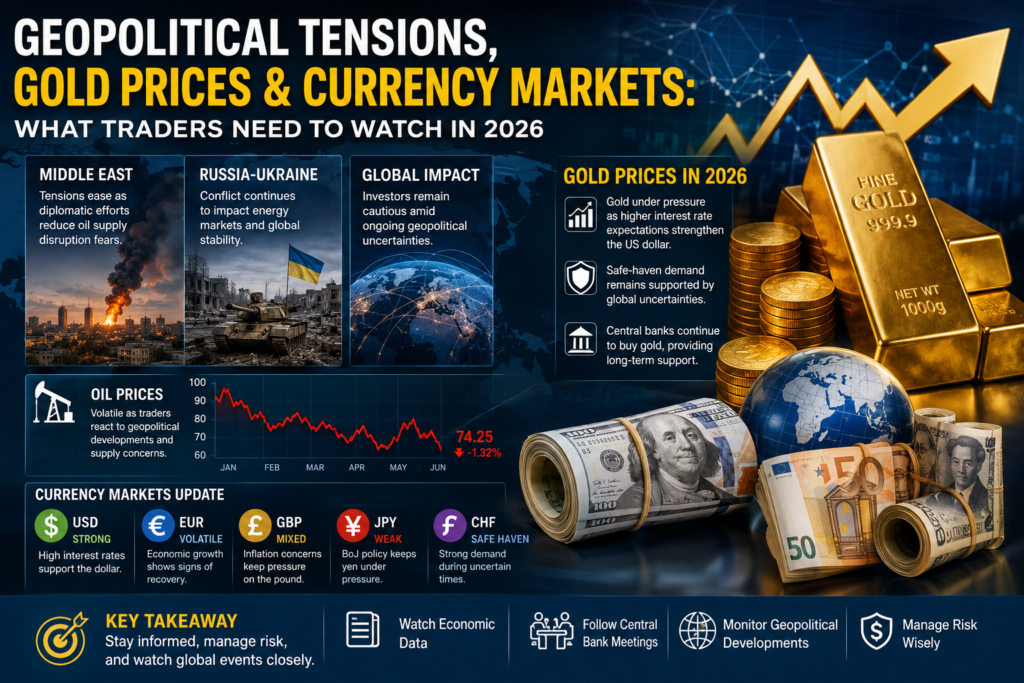
Recent diplomatic efforts involving Iran and Western nations have eased some concerns about disruptions in oil supply routes. As tensions surrounding the Strait of Hormuz have moderated, oil markets have experienced increased supply expectations, reducing fears of a prolonged energy crisis. Analysts estimate that significant oil inventories may return to global markets if diplomatic progress continues.
However, market participants remain cautious. Energy infrastructure damage and production disruptions from earlier conflicts may take months to fully recover, keeping volatility elevated in oil markets.
Why This Matters for Traders
When geopolitical tensions rise:
- Oil prices often increase.
- Inflation expectations rise.
- Central banks may delay interest rate cuts.
- Safe-haven assets like gold become more attractive.
When tensions ease:
- Oil prices generally decline.
- Risk appetite improves.
- Equity markets benefit.
- Gold may face selling pressure.
Understanding this cycle is crucial for anyone trading commodities, forex, or equities.
Gold Prices Under Pressure Despite Global Uncertainty
Gold traditionally benefits during periods of geopolitical uncertainty. However, 2026 has shown that interest rates can sometimes have a greater influence on gold than geopolitical headlines.
Recent market data shows gold prices falling as investors anticipate a more hawkish stance from the U.S. Federal Reserve. A stronger U.S. dollar and expectations of future rate hikes have reduced demand for non-yielding assets such as gold.
Spot gold recently declined as traders adjusted their expectations regarding future monetary policy. The stronger dollar has made gold more expensive for international buyers, contributing to downward pressure on prices.
Key Factors Affecting Gold in 2026
1. Federal Reserve Policy
Interest rates remain one of the most significant drivers of gold prices.
Higher rates:
- Strengthen the U.S. dollar.
- Increase bond yields.
- Reduce the appeal of gold.
Lower rates:
- Weaken the dollar.
- Support precious metals.
- Encourage investment demand.
2. Geopolitical Risks
Conflicts involving major oil-producing nations continue to support long-term demand for safe-haven assets.
3. Inflation Expectations
Gold remains a popular hedge against inflation. Any resurgence in global inflation could support higher gold prices.
4. Central Bank Purchases
Many central banks continue increasing their gold reserves as part of diversification strategies, providing long-term support for the metal.
Currency Markets React to Economic and Political Developments
The foreign exchange market has become increasingly sensitive to geopolitical news.
Major currencies such as the U.S. dollar, euro, British pound, Japanese yen, and Swiss franc have experienced heightened volatility as investors adjust their expectations regarding economic growth and interest rates.
U.S. Dollar Remains Strong
The U.S. dollar continues to benefit from:
- Higher interest rates.
- Strong economic performance.
- Safe-haven demand during uncertain periods.
A stronger dollar typically weighs on commodities such as gold and silver because they are priced in dollars globally.
Emerging Market Currencies Face Pressure
Countries dependent on energy imports remain vulnerable to fluctuations in oil prices.
If oil prices rise significantly:
- Import costs increase.
- Trade deficits widen.
- Local currencies weaken.
If oil prices fall:
- Inflation pressures ease.
- Economic growth improves.
- Currency stability increases.
Russia-Ukraine Conflict Remains a Global Risk
While market attention has shifted toward the Middle East, the Russia-Ukraine conflict continues to influence global commodity and energy markets.
Recent reports indicate intensified Ukrainian strikes targeting critical infrastructure in Crimea, affecting logistics, fuel distribution, and regional economic activity. These developments highlight the continued geopolitical risks facing Europe and global markets.
Investors should continue monitoring:
- Energy supply disruptions.
- European economic growth.
- Sanctions and trade restrictions.
- Currency volatility in the euro region.
Oil Prices: The Key Link Between Geopolitics and Markets
Oil remains one of the most geopolitically sensitive assets.
Earlier in June, escalating tensions in the Middle East caused oil prices to surge sharply as traders feared supply disruptions. Subsequent diplomatic progress helped reduce these concerns, leading to a pullback in crude prices.
What Could Drive Oil Higher Again?
Potential catalysts include:
- New sanctions on oil-producing nations.
- Shipping disruptions.
- Military escalation in strategic waterways.
- Unexpected production cuts.
What Could Push Oil Lower?
- Successful peace negotiations.
- Increased production.
- Weak global demand.
- Economic slowdowns.
For forex traders, oil price movements often influence currencies such as:
- Canadian Dollar (CAD)
- Norwegian Krone (NOK)
- Russian Ruble (RUB)
- Gulf-region currencies
Gold Trading Strategy for the Second Half of 2026
Traders should focus on three primary themes:
Bullish Scenario
Gold could rally if:
- Geopolitical tensions escalate.
- Inflation rises unexpectedly.
- Central banks adopt dovish policies.
- The U.S. dollar weakens.
Bearish Scenario
Gold could face further pressure if:
- Interest rates remain elevated.
- The U.S. dollar strengthens.
- Risk appetite improves.
- Global conflicts continue to de-escalate.
Neutral Scenario
Gold may consolidate if markets remain uncertain while central banks maintain current policies.
What Investors Should Watch Next
Several upcoming events could significantly impact global markets:
Economic Data Releases
Key indicators include:
- U.S. inflation data
- Employment reports
- GDP growth figures
- Consumer spending trends
Central Bank Meetings
Decisions from major central banks could reshape expectations for interest rates and currency movements.
Geopolitical Developments
Investors should monitor:
- Middle East negotiations
- Russia-Ukraine developments
- Global energy supply chains
- International trade relations
Conclusion
The relationship between geopolitics, gold, oil, and currency markets remains stronger than ever in 2026.
While recent diplomatic progress has reduced some fears surrounding global energy supplies, geopolitical risks remain elevated. Gold prices continue to face pressure from a strong U.S. dollar and higher interest rates, while currency markets remain highly sensitive to economic and political developments.
For traders and investors, staying informed about global events is essential. The coming months are likely to bring continued volatility across commodities, currencies, and financial markets, creating both risks and opportunities.
Those who understand the connection between geopolitical events and market behavior will be better positioned to navigate the evolving global financial landscape.
FAQs
Why does gold rise during geopolitical tensions?
Gold is considered a safe-haven asset, meaning investors often buy it during periods of uncertainty.
How do oil prices affect currencies?
Higher oil prices generally benefit oil-exporting countries while creating challenges for oil-importing nations.
Is gold a good investment in 2026?
Gold remains an important diversification asset, but its performance depends on interest rates, inflation, and geopolitical developments.
What is the biggest risk to financial markets right now?
Geopolitical instability combined with uncertain monetary policy remains one of the largest risks facing investors globally.