
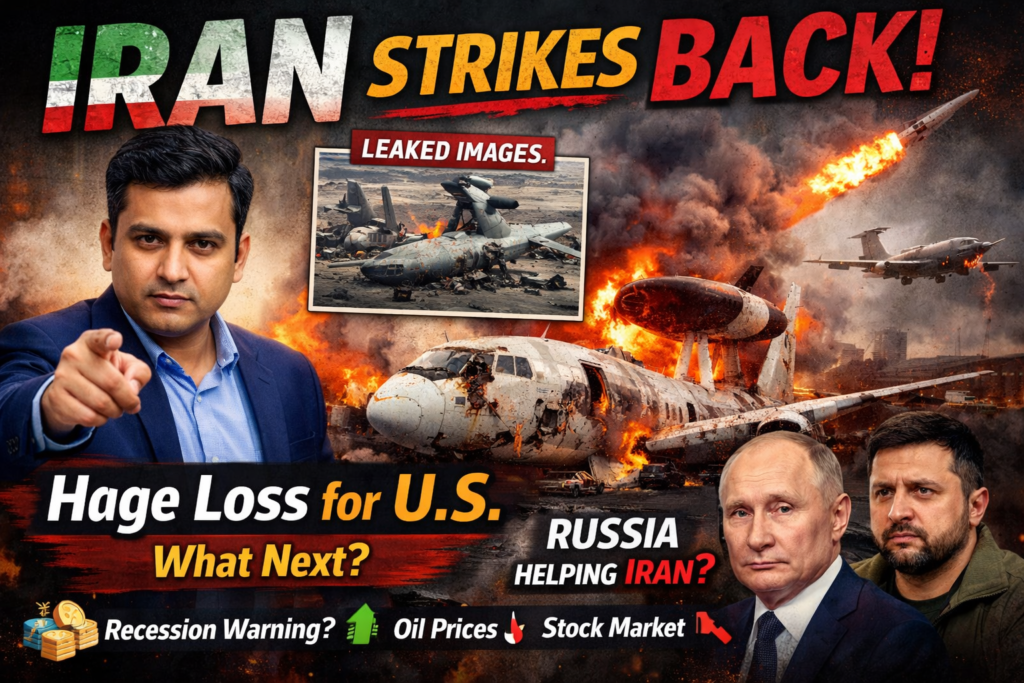
At present, Iran is fighting back strongly. Recently, Iran has caused significant damage to the US Air Force. I had told you months ago that a major war between the US and Iran was likely, and defeating Iran would not be easy for the US.
But right now, Iran is performing even better than expected. There is no sign of fear—neither of the US having nuclear weapons nor of Israel taking action. Iran is fighting fearlessly against the United States.
So far, the US Air Force has suffered losses worth around $3 billion. Iran has destroyed air defense systems, aircraft, radars, and drones, and continues to launch missiles at US airbases in Saudi Arabia, Qatar, UAE, and other locations.
In the latest attack on Saudi Arabia, the US suffered one of its biggest losses. At the Prince Sultan Airbase—used by both Saudi and US air forces—Iran launched a major attack on March 27, 2026, using missiles and drones, causing massive destruction.
Initially, the US tried to downplay the damage, similar to past tactics. However, leaked images—possibly with involvement from journalists or even Russia—revealed the true extent of the damage.
One of the major losses includes the destruction of a US E-3 AWACS (Airborne Warning and Control System). This aircraft doesn’t attack but provides critical intelligence about enemy movements, missiles, and fighter jets. Its presence significantly enhances the capability of other fighter jets.
Iran destroyed this system, causing losses between $500–700 million in this attack alone. Refueling aircraft were also destroyed. This is a massive and difficult-to-replace loss for the US Air Force.
Such destruction of an AWACS is extremely rare. The leaked images from the Saudi airbase are embarrassing for the US, showing how Iran managed to damage such critical assets.
Iran has also been active in narrative warfare—posting videos, memes, and social media content showing their confidence. For example, after the March 27 attack, Iran released a video showing missile launches, with a spokesperson casually drinking juice in the background—symbolizing fearlessness.
Even US analysts are acknowledging Iran’s unexpected dominance in social media propaganda and narrative warfare. Compared to this, countries like India and Pakistan are far behind in PR and narrative strategy.
Reports from US media, including the Wall Street Journal, suggest that replacing the damaged systems could cost over $700 million, and immediate replacements are not available.
This level of damage was likely not anticipated by Donald Trump. As a result, the US may escalate further, possibly preparing for a ground invasion.
If US soldiers enter Iran and face heavy losses, analysts predict that the US might consider drafting young citizens under 30 into military service—similar to what has been seen in Russia.
Regarding how Iran is achieving such precision strikes without advanced satellite capabilities—the answer lies in Russia’s support.
Ukrainian President Zelensky has alleged that Russia is providing Iran with intelligence, coordinates, and targeting data to maximize damage against US assets. The UK Defense Secretary has also suggested this may be part of a covert Russian operation called “Operation Hidden Hand,” aimed at countering US operations.
Unless Trump takes a major U-turn, the US risks severe consequences. This war could become a defining moment in US history. Economic impacts are already visible—fuel prices are rising, stocks are falling, and even wealthy Americans are concerned.
About 55% of Americans are invested in the stock market, compared to only 6–7% in India. The US stock market has already fallen over 12%, and further declines are expected if the war escalates.
If a long war continues, fuel prices will rise further and economic damage will deepen. However, if the US changes course, the economy might still be saved. Otherwise, this could lead to long-term consequences remembered for years.