Documents Most Hospitals Ask For Before Cashless Treatment

Cashless treatment sounds simple — show your card and get treated.
In reality, most delays and rejections happen because documents are missing or incorrect.

Whether you’re using ECHS, Ayushman Bharat, CGHS, or any government/insurance scheme, hospitals follow a strict verification process before approving cashless treatment.

This article explains exactly which documents hospitals usually ask for, why they matter, and how to prepare in advance.


Why Hospitals Ask for Documents Before Cashless Treatment

Hospitals don’t get paid immediately in cashless cases.
They are reimbursed later by the government or insurance authority.

So before approving treatment, hospitals must confirm:

  • You are eligible
  • The scheme is valid
  • The treatment is covered
  • Documents can stand audit checks

Even one missing document can delay or stop approval.


1️⃣ Identity Proof (Mandatory)

Almost every hospital asks for government-issued ID.

Commonly accepted IDs:

  • Aadhaar Card
  • PAN Card
  • Voter ID
  • Defence ID (for ECHS beneficiaries)

📌 Tip:
Carry original + 1–2 photocopies. Some hospitals keep copies in records.


2️⃣ Health Scheme Card / Smart Card

This is the most critical document.

Examples:

  • ECHS Smart Card
  • Ayushman Bharat (PM-JAY) Card
  • CGHS Card
  • State Health Scheme Card

Hospitals verify:

  • Card validity
  • Beneficiary name
  • Dependency status
  • Scheme category (ward entitlement, limits)

⚠️ Expired, blocked, or inactive cards can stop cashless approval.


3️⃣ Referral Letter (Very Important for Government Schemes)

Many people miss this step.

Schemes like ECHS and CGHS often require:

  • First visit to polyclinic / primary center
  • Referral letter for hospitalisation or specialist treatment

Without referral:

  • Cashless request may be rejected
  • Treatment may shift to reimbursement mode

📌 Always ask the hospital before admission if referral is required.


4️⃣ Doctor’s Prescription / Admission Advice

Hospitals need proof that:

  • Admission is medically required
  • Treatment is not elective or unnecessary

Usually includes:

  • Diagnosis
  • Reason for admission
  • Expected treatment or surgery

This document is uploaded during pre-authorization.


5️⃣ Pre-Authorization Form (Hospital Handles, But You Must Sign)

For cashless treatment:

  • Hospital submits a pre-auth request online
  • Patient or attendant signs consent forms

You may be asked to provide:

  • Signature
  • Mobile number (OTP verification in some schemes)

📌 Delays often happen if the patient is unavailable to sign.


6️⃣ Dependent Proof (If Applicable)

If treatment is for:

  • Spouse
  • Parents
  • Children

Hospitals may ask:

  • Relationship proof
  • Dependency declaration
  • Updated dependent details in the system

For ECHS especially:

  • Dependents must be registered and active
  • Income limits may apply for parents

7️⃣ Recent Photographs (Sometimes Required)

Some hospitals still ask for:

  • Passport-size photos
  • Especially for new registrations or emergency cases

Not always mandatory, but useful to keep.


8️⃣ Previous Medical Records (Recommended)

Not mandatory, but strongly advised:

  • Old prescriptions
  • Test reports
  • Discharge summaries (if repeat admission)

These help:

  • Faster approval
  • Better treatment justification
  • Avoid claim disputes later

9️⃣ Mobile Number Linked to Scheme

Many schemes now use:

  • OTP verification
  • SMS alerts for approval status

Make sure:

  • Registered mobile number is active
  • Phone is with patient or attendant

10️⃣ Emergency Cases – What Changes?

In emergencies:

  • Treatment may start immediately
  • Documents are collected within 24–48 hours

⚠️ If documents are not submitted later:

  • Cashless approval can be cancelled
  • Hospital may ask for payment

Common Reasons Cashless Requests Get Rejected

Based on real cases, top reasons include:

  • No referral letter
  • Card not active or blocked
  • Treatment not covered under scheme
  • Wrong hospital (not empanelled)
  • Dependent not eligible

Simple Checklist (Save This)

Before going to hospital, carry:
✔ ID proof
✔ Health scheme card
✔ Referral letter (if required)
✔ Doctor’s prescription
✔ Dependent documents
✔ Registered mobile phone


Final Advice

Cashless treatment works smoothly only when paperwork is ready.
Most problems happen not because of hospitals — but because beneficiaries are unaware of requirements.

Preparing documents in advance can:

  • Save time
  • Reduce stress
  • Prevent last-minute payments

ECHS vs Ayushman Bharat – Which Is Better for Defence Families?

Both ECHS and Ayushman Bharat offer healthcare, but they serve different purposes.


Comparison Table

FeatureECHSAyushman Bharat
EligibilityEx-servicemenIncome-based
CoverageLifetime₹5 lakh/year
HospitalsDefence & privatePrivate & govt
MedicinesFreeLimited
DependentsIncludedFamily based

Which Should Defence Families Choose?

  • Serving/Retired Defence Personnel: ECHS
  • Low-income civilian families: Ayushman Bharat
  • Dual eligibility: Use carefully (no double claim)

👉 ECHS benefits
👉ECHS claim status


Final Verdict

For defence families, ECHS is superior in long-term medical security, while Ayushman Bharat is a strong backup option where applicable.

What Benefits Do War Widows Get in India? (Complete Guide)

War widows, also known as Veer Naris, receive special recognition and support from the Government of India.


1. Family Pension & Liberalised Pension

  • Enhanced pension benefits
  • Additional allowances
  • Lifetime financial security

2. Healthcare Benefits (ECHS)

  • Full ECHS membership
  • Cashless treatment
  • No contribution required in many cases

👉 Internal link: ECHS eligibility


3. Education Benefits for Children

  • Scholarships
  • Fee concessions
  • Priority admissions

4. Housing & Welfare Support

  • Priority in AWHO housing
  • State government assistance
  • Zila Sainik Board support

5. Employment & Skill Support

  • Reserved government jobs
  • Skill development programs

Conclusion

War widows are supported not just financially, but with dignity, healthcare, housing, and education benefits, ensuring a secure future.

Medical Benefits for Army Veterans After Retirement

After retirement, Army veterans need reliable healthcare support. The Indian government ensures this through structured medical benefit systems, primarily ECHS.


Primary Medical Benefits Available

1. ECHS Medical Facilities

  • OPD & specialist consultation
  • Diagnostics & imaging
  • Free medicines

👉 Internal link: ECHS login
👉 Internal link: ECHS reimbursement process


Emergency Medical Coverage

  • Treatment at non-empanelled hospitals
  • Claim reimbursement later
  • Emergency certificate required

Coverage for Dependents

  • Spouse
  • Children (as per rules)
  • Dependent parents

Common Medical Claims

  • Surgery reimbursement
  • Medicine bill claims
  • Diagnostic reimbursement

Conclusion

ECHS acts as a lifeline healthcare system for retired Army personnel, ensuring dignity and care throughout post-service life.

Best Government Benefits for Defence Pensioners in India

Defence pensioners are entitled to multiple government benefits beyond monthly pension. These benefits cover healthcare, travel, housing, education, and financial security.


1. Defence Pension & Family Pension

  • Regular pension via PCDA
  • Dearness Relief (DR)
  • Family pension for widows

2. Healthcare Benefits (ECHS)

  • Lifetime medical coverage
  • Dependents included
  • Emergency reimbursement

👉 Internal link: ECHS login
👉 Internal link: ECHS claim status


3. Travel Benefits

  • Railway concessions
  • MCO quota train reservations
  • Priority defence travel support

4. CSD (Canteen Stores Department)

  • Discounted groceries
  • Vehicles at subsidised prices
  • Medicines at reduced rates

5. Housing & Welfare Schemes

  • AWHO housing projects
  • State welfare housing assistance
  • One-rank-one-pension related support

Conclusion

Government benefits significantly reduce post-retirement financial burden for defence pensioners. Awareness is key to fully utilising these schemes.

ECHS Smart Card Documents Required – Complete Checklist (2026)

Submitting correct documents is essential for ECHS Smart Card approval. Missing or incorrect paperwork is the top reason for delays.


Mandatory Documents (Primary Beneficiary)

  • Aadhaar Card
  • PAN Card
  • PPO copy
  • Discharge Book
  • Passport-size photograph
  • Signature / thumb impression

Documents for Dependents

  • Aadhaar & PAN (above 18 years)
  • Birth certificate / school certificate
  • Self-declaration affidavit
  • Income proof (parents)
  • Disability certificate (if applicable)

Special Documents (If Applicable)

  • DPDO / Banker’s certificate (non-FMA)
  • Divorce decree (for divorced daughter)
  • Death certificate (for widow cases)
  • Medical board certificate for White Card

Important Notes

  • All documents must be self-attested
  • Upload clear scanned copies
  • Originals required during card collection

ECHS vs Ayushman Bharat – Detailed Comparison (2026 Guide)

Many Ex-Servicemen and their families often ask a very important question:

“Should I rely only on ECHS, or should I also use Ayushman Bharat?”

Both are government-backed healthcare schemes, but they are designed for very different audiences and work in completely different ways.

This detailed comparison will help you understand which scheme is better, when to use which, and how to combine both smartly.


🏥 What is ECHS?

ECHS (Ex-Servicemen Contributory Health Scheme) is a dedicated healthcare scheme exclusively for defence veterans and their dependents.

Designed For:

  • Ex-Servicemen pensioners
  • War widows & family pensioners
  • Eligible dependents

Core Focus:

👉 Lifetime medical care
👉 OPD + medicines + hospitalisation
👉 Cashless & reimbursement-based system


🏥 What is Ayushman Bharat (PM-JAY)?

Ayushman Bharat – Pradhan Mantri Jan Arogya Yojana (PM-JAY) is a nationwide health insurance scheme for economically weaker citizens.

Designed For:

  • Low-income households
  • SECC database beneficiaries
  • Selected state health card holders

Core Focus:

👉 Hospitalisation insurance only
👉 ₹5 lakh coverage per family per year
👉 Cashless treatment at empanelled hospitals


🔍 ECHS vs Ayushman Bharat – Quick Comparison Table

FeatureECHSAyushman Bharat (PM-JAY)
Target GroupDefence VeteransEconomically Weaker Citizens
OPD Coverage✅ Yes❌ No
Free Medicines✅ Yes❌ No
Hospitalisation✅ Cashless & Reimbursement✅ Cashless Only
Annual Limit❌ No fixed limit₹5 lakh per year
Lifetime Validity✅ Yes❌ Yearly limit
Emergency Coverage✅ Yes (any hospital)❌ Limited
Chronic Diseases✅ Fully covered❌ Limited
Referral Required✅ Usually❌ No
Dependents Covered✅ Yes✅ Yes
ContributionOne-timeFree

💊 Medicines Coverage – Biggest Difference

ECHS

✔ Free medicines from polyclinic
✔ Chronic illness medicines
✔ Cancer, cardiac, dialysis drugs
✔ Reimbursement if unavailable

Ayushman Bharat

❌ No OPD medicines
❌ Medicines only during hospital stay

📌 For long-term treatment, ECHS is far superior.


🚑 Emergency Treatment Comparison

ECHS

  • Emergency treatment allowed at any hospital
  • Reimbursement permitted
  • Later verification by ECHS polyclinic

Ayushman Bharat

  • Only empanelled hospitals
  • No reimbursement if treated outside
  • Strict package-based treatment

🧾 Claim & Paperwork Comparison

ECHS

✔ Referral-based system
✔ Smart card verification
✔ Online bill processing
✔ Detailed documentation

Ayushman Bharat

✔ Aadhaar-based verification
✔ Instant cashless admission
✔ Minimal paperwork

📌 Ayushman Bharat is simpler, ECHS is more comprehensive.


👨‍👩‍👧 Coverage for Family & Widows

ECHS

  • Widows covered for life
  • Parents covered (income criteria)
  • Disabled children covered for life

Ayushman Bharat

  • Family defined by SECC norms
  • Limited yearly coverage
  • No special veteran provisions

🏥 Hospital Network Reach

ECHS

  • ECHS Polyclinics across India
  • Military hospitals
  • Selected private empanelled hospitals

Ayushman Bharat

  • Very large network
  • Strong presence in rural & tier-2 cities
  • More private hospitals

📌 Ayushman Bharat has wider geographic reach, but fewer services.


✅ Which Scheme Is Better?

Choose ECHS if:

✔ You are an Ex-Serviceman or widow
✔ You need regular OPD care
✔ You have chronic illnesses
✔ You want lifelong healthcare

Choose Ayushman Bharat if:

✔ You qualify under income criteria
✔ You need occasional hospitalisation
✔ You live in remote areas without ECHS


⭐ Best Strategy: Use BOTH (If Eligible)

Many veterans legally use both schemes:

  • ECHS → OPD, medicines, long-term care
  • Ayushman Bharat → Backup hospitalisation in remote areas

⚠️ Claims cannot be duplicated, but schemes can complement each other.

How to Get Medicines from ECHS Polyclinic – Complete Guide (2026)

Getting medicines through the Ex-Servicemen Contributory Health Scheme (ECHS) is one of the most important benefits for ex-servicemen and their dependents. However, many beneficiaries are confused about where to collect medicines, what documents are required, and what to do if medicines are not available.

This 2026 updated guide explains everything step-by-step so you can get your medicines smoothly from an ECHS polyclinic without delays or rejection issues.


✅ What Is an ECHS Polyclinic Pharmacy?

An ECHS Polyclinic Pharmacy is the authorized medicine dispensing unit attached to an ECHS polyclinic. It provides free medicines to eligible ECHS beneficiaries as per approved prescriptions.

Medicines are issued based on:

  • Doctor’s prescription from ECHS polyclinic
  • Availability in stock
  • Approved ECHS / CGHS medicine list

👥 Who Can Get Medicines from ECHS Polyclinic?

The following beneficiaries are eligible:

  • Ex-servicemen registered under ECHS
  • Dependents listed on the ECHS smart card
  • Widows of ex-servicemen
  • Disabled dependents covered under ECHS

📌 Your ECHS Smart Card must be valid at the time of medicine issue.


📝 Documents Required to Get Medicines from ECHS Polyclinic

Carry these documents every time you visit:

✔ Original ECHS Smart Card
Prescription issued by ECHS doctor
✔ OPD slip (if issued)
✔ Identity proof (if asked)

📌 Prescriptions from private doctors are not accepted unless routed through ECHS.


🏥 Step-by-Step: How to Get Medicines from ECHS Polyclinic

Step 1: Visit ECHS Polyclinic OPD

  • Consult the ECHS Medical Officer or specialist.
  • Explain your medical condition.
  • Get a computer-generated prescription.

Step 2: Submit Prescription at Pharmacy Counter

  • Go to the ECHS pharmacy inside the polyclinic.
  • Submit the prescription along with ECHS card.
  • Pharmacy staff verifies medicine availability.

Step 3: Collect Medicines

  • If medicines are available, they are issued immediately.
  • Quantity is usually for 30 days (or as per condition).
  • For chronic diseases, longer duration may be allowed.

🚫 What If Medicines Are Not Available in ECHS Polyclinic?

This is a common issue, and ECHS has a clear solution.

Option 1: Authorized Local Chemist (ALC)

  • Polyclinic forwards the prescription to an ALC.
  • Medicines are arranged within 48–72 hours.
  • You will be informed when to collect them.

Option 2: Non-Availability (NA) Certificate

If medicines are not available even through ALC:

✔ Polyclinic issues an NA Certificate
✔ You are allowed to buy medicines from outside
✔ Bills can be claimed for reimbursement

⚠️ Without NA Certificate, reimbursement is NOT allowed.


💊 Buying Medicines from Outside Pharmacy – Rules

You can buy medicines outside only if:

  • NA Certificate is issued
  • Prescription is from ECHS doctor
  • Bills are GST-compliant
  • Pharmacy bill has stamp & signature

💰 How to Claim Reimbursement for Medicines Bought Outside

You can submit a medicine reimbursement claim if:

  • Medicines were unavailable at ECHS
  • NA Certificate is attached

Required Documents:

✔ ECHS Card copy
✔ Prescription
✔ Original medicine bills
✔ NA Certificate
✔ Cancelled cheque

Claims can be submitted online or at polyclinic, depending on current SOP.


⏳ How Often Can Medicines Be Collected?

  • Usually once per month
  • Chronic patients may receive longer duration
  • Early refills require doctor’s approval

🚑 Emergency Medicine Purchase Rules

In emergencies:

  • Medicines can be bought immediately from outside
  • Emergency justification is required
  • Reimbursement subject to scrutiny

❌ Common Mistakes to Avoid

❌ Using private doctor prescription
❌ Buying medicines without NA Certificate
❌ Submitting handwritten bills
❌ Missing GST details on bill
❌ Claiming medicines not prescribed


❓ Frequently Asked Questions (FAQs)

Can I get medicines without visiting ECHS doctor?

No. Medicines are issued only against ECHS prescriptions.

Are branded medicines allowed under ECHS?

Equivalent generic medicines are preferred as per availability.

Can dependents collect medicines?

Yes, if they are listed on the ECHS card.

Is there a limit on medicine cost?

Yes. Claims are processed as per approved rates.


✅ Final Words

Getting medicines from an ECHS polyclinic is simple if you follow the correct process. Always ensure:

  • Valid ECHS prescription
  • NA Certificate when required
  • Proper bills for reimbursement

This will help you avoid claim rejection and delays.


🔗 Recommended Internal Links (Add on your site)

  • ECHS Medicine Bill Claim Online
  • ECHS Claim Status Check
  • ECHS Claim Rejected – Reasons & Fixes

ECHS Claim Rejected Due to Missing Documents? Complete Checklist (2026 Guide + PDF)

One of the most common reasons for ECHS claim rejection is missing or incomplete documents. Even a small mistake—such as an unreadable bill or a missing prescription—can lead to your reimbursement being delayed or rejected.

If your ECHS claim was rejected due to missing documents, don’t worry. In most cases, the claim can be corrected and resubmitted.

This 2026 updated guide explains:

  • Why ECHS claims get rejected for missing documents
  • A complete document checklist for OPD, IPD & Pharmacy claims
  • How to fix and resubmit a rejected claim
  • Tips to avoid rejection in the future

✅ Why ECHS Claims Are Rejected Due to Missing Documents

ECHS follows strict audit and CGHS-based guidelines. If any mandatory document is missing, unclear, or invalid, the Bill Processing Agency (BPA) cannot process the claim.

Common document-related issues include:

  • Missing discharge summary
  • Prescription not uploaded
  • Cancelled cheque missing
  • Bills without stamp or GST number
  • Wrong document uploaded under wrong category

📋 Complete ECHS Claim Document Checklist (2026)

Use this checklist before submitting or resubmitting your claim.


🏥 IPD Claim (Hospital Admission) – Mandatory Documents

You must upload ALL of the following:

✔ Copy of ECHS Smart Card
Discharge Summary (signed & stamped)
Emergency Certificate (if hospital was non-empanelled)
Original Hospital Bills (itemized)
Payment Receipts
Doctor’s Prescription
Investigation / Lab Reports
Operation Notes (if surgery done)
Copy of Cancelled Cheque (beneficiary account)

📌 Missing even one document can result in rejection.


💊 OPD Claim – Mandatory Documents

✔ ECHS Card copy
✔ Doctor’s prescription
✔ OPD consultation bill
✔ Investigation bills (if any)
✔ Cancelled cheque copy

📌 OPD claims submitted without prescription are automatically rejected.


🏪 Pharmacy / Medicine Bill Claim – Mandatory Documents

✔ ECHS Card copy
✔ Doctor’s prescription
Medicine bills with GST number
✔ Pharmacy stamp & signature
✔ Cancelled cheque

📌 Handwritten bills or bills without GST are not accepted.


🚫 Common Missing Document Mistakes That Cause Rejection

❌ Prescription uploaded but not signed
❌ Cancelled cheque not matching beneficiary name
❌ Discharge summary without diagnosis
❌ Bills uploaded as blurred images
❌ Wrong document uploaded under wrong section
❌ Missing emergency justification for private hospital treatment


🔄 What To Do If Your ECHS Claim Is Rejected for Missing Documents

✅ Step 1: Check Rejection Remarks

Login to the ECHS portal and read the exact rejection reason.

✅ Step 2: Arrange Missing Documents

Collect the required document(s) from:

  • Hospital
  • Pharmacy
  • Bank (for cancelled cheque)

✅ Step 3: Resubmit Claim (If Returned)

If status is “Returned”, upload documents and resubmit online.

❌ If Status Is “Rejected”

  • Contact your ECHS Polyclinic
  • Submit clarification or appeal (if allowed)

📥 ECHS Claim Missing Documents Checklist (PDF)

📌 Recommended:
Create a printable PDF checklist from this article so users can:

  • Tick documents before submission
  • Avoid repeat rejections
  • Keep records safely

This type of PDF improves:

  • User engagement
  • AdSense session duration
  • Repeat visits

🛡️ Tips to Avoid Document-Related Rejection in Future

✔ Scan documents clearly (PDF preferred)
✔ Keep file size within portal limits
✔ Upload documents in correct category
✔ Match beneficiary name on cheque
✔ Submit claims as early as possible
✔ Keep copies for at least 1 year


❓ FAQs – Missing Documents & ECHS Claims

Q. Can I resubmit a rejected ECHS claim?

Yes, if the claim is returned due to missing documents. Final rejections depend on case review.

Q. Is cancelled cheque mandatory?

Yes, for all reimbursement claims.

Q. Are handwritten medical bills accepted?

No. Bills must be computer-generated with GST details.

Q. What happens if discharge summary is missing?

IPD claims without discharge summary are rejected.


✅ Final Words

Most ECHS claim rejections due to missing documents are preventable. Using this complete checklist, you can submit error-free claims and avoid unnecessary delays.

📌 Bookmark this page
📌 Download the checklist
📌 Always verify before submission

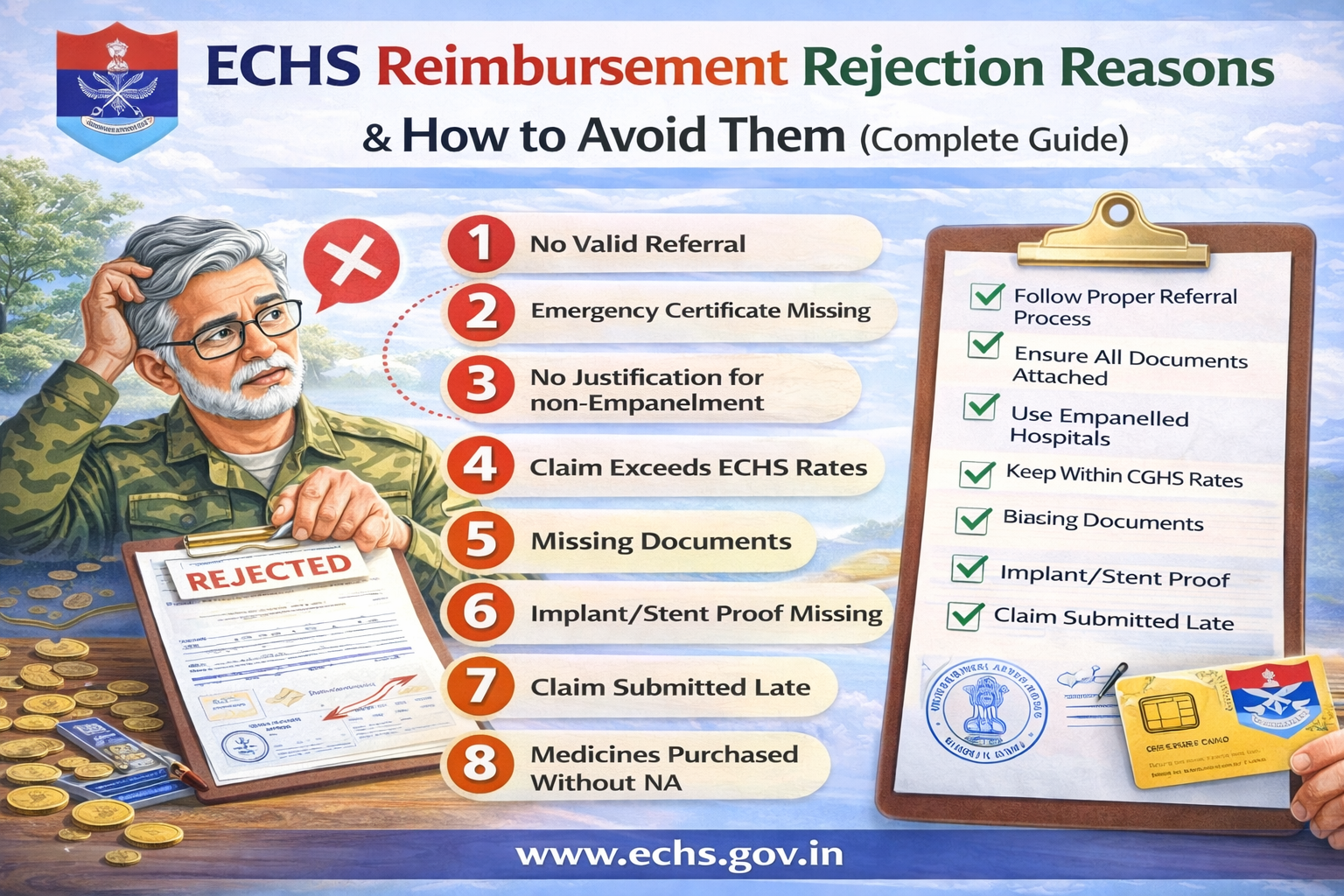
ECHS Reimbursement Rejection Reasons & How to Avoid Them (Complete Guide)

ECHS reimbursement claims are often rejected or delayed due to small procedural errors rather than medical issues. Understanding the common rejection reasons and knowing how to avoid them can save Ex-Servicemen and their families significant time, stress, and money.

This guide explains why ECHS claims get rejected and gives practical solutions to ensure smooth approval.


What Is ECHS Reimbursement?

ECHS reimbursement applies when:

  • Treatment is taken in a non-empaneled hospital (usually emergency), or
  • Payment is made by the beneficiary and later claimed, or
  • Certain medicines/tests are not available at ECHS dispensaries.

Reimbursement is processed strictly as per ECHS SOP & CGHS rates.


Top Reasons for ECHS Reimbursement Rejection

1. ❌ Treatment Without Valid Referral

Reason

  • No ECHS referral letter attached
  • Referral expired (valid only for 1 month, except oncology)

How to Avoid

  • Always obtain referral from ECHS Polyclinic
  • For follow-ups, ensure referral clearly mentions duration
  • Keep photocopies of all referrals

2. ❌ Emergency Certificate Missing or Invalid

Reason

  • Emergency treatment taken but no emergency certificate
  • Certificate not signed/stamped by hospital authority

How to Avoid

  • Obtain Emergency Certificate + EIR
  • Hospital must inform ECHS within 48 hours
  • Emergency must match approved emergency conditions

3. ❌ Treatment in Non-Empanelled Hospital Without Justification

Reason

  • Empanelled hospital available but not used
  • No proof of non-availability

How to Avoid

  • Use empanelled hospital whenever possible
  • Attach NA (Non-Availability) Certificate if applicable

4. ❌ Claim Exceeds CGHS/ECHS Rates

Reason

  • Hospital charges higher than approved rates
  • Private ward used without entitlement

How to Avoid

  • Check ward entitlement based on rank
  • Reimbursement limited to CGHS rates, even if paid more

5. ❌ Missing or Incomplete Documents

Reason

  • Missing discharge summary
  • Bills not itemized
  • Reports not signed or stamped

How to Avoid
Attach all mandatory documents:

  • Referral letter
  • Discharge summary
  • Itemized bill + final bill
  • Investigation reports
  • Implant invoices & stickers (if applicable)

6. ❌ Implant / Stent Proof Not Attached

Reason

  • Implant pouch/sticker missing
  • Invoice does not mention patient name or batch number

How to Avoid

  • Always collect:
    • Implant outer pouch
    • Batch number sticker
    • Original invoice

Without these, implant cost is rejected fully.


7. ❌ Delay in Submission of Claim

Reason

  • Claims submitted after 1 month from discharge
  • No delay waiver approval

How to Avoid

  • Submit claim immediately
  • Delay up to 6 months → Station Commander approval
  • Beyond 1 year → Central Organisation decision

8. ❌ Medicines Purchased Without NA Certificate

Reason

  • Medicines available in ECHS dispensary
  • No NA certificate from polyclinic

How to Avoid

  • Collect NA certificate before purchasing medicines
  • Only specific cases allow medicine reimbursement

9. ❌ OPD Claims Without Proper Proof

Reason

  • OPD slip missing
  • Doctor’s signature absent

How to Avoid

  • Attach:
    • Referral letter
    • OPD consultation slip
    • Doctor’s signature & stamp

10. ❌ Package Procedure Billed Incorrectly

Reason

  • Extra charges billed during package period
  • Diet, nursing, ICU billed separately

How to Avoid

  • Package includes:
    • Room rent
    • Medicines
    • Nursing
    • Investigations
  • Extra billing allowed only beyond package duration with approval

How to Ensure 100% Claim Approval

✅ Before Treatment

  • Verify empanelled hospital
  • Confirm ward entitlement
  • Collect referral or emergency certificate

✅ During Hospitalization

  • Keep all reports
  • Ask hospital for ECHS-compliant billing

✅ After Discharge

  • Arrange documents chronologically
  • Number each page
  • Submit both online (UTIITSL) and physical copy

What to Do If Your ECHS Claim Is Rejected?

  1. Ask polyclinic for written rejection reason
  2. Rectify documents (if curable)
  3. Resubmit claim
  4. If unjustified, appeal through Regional Centre → Central Organisation

Claims cannot be rejected at intermediate levels without forwarding.


Frequently Asked Questions (FAQs)

❓ Can ECHS reject a claim completely?

Yes, if:

  • No emergency
  • Fraudulent claim
  • Non-compliance with SOP

❓ Is ambulance reimbursement allowed?

❌ No. Ambulance charges are not admissible.


❓ Can I claim from insurance and ECHS both?

Yes, but ECHS reimburses only the balance after insurance.


❓ How long does reimbursement take?

  • Normal cases: 30–60 days
  • High-value cases (>5 lakhs): longer due to MoD approval

Final Advice for ECHS Beneficiaries

Most ECHS claim rejections are avoidable.
Proper referral, correct documentation, and timely submission are the keys to hassle-free reimbursement.